

The work
FOKKOL is a South African brand built around one word that means “nothing.” The brilliance of it lies in how little it tries. There is no separate launch, no extra tagline, no ad copy in search of a headline. The brand is the copy. The campaign runs all year, powered by language, humour and local pride. It proves that a clever idea, built on truth and tone, does not need advertising to advertise itself.
It began as a family joke in the Karoo, a single word that means “nothing.” Put the word on a shirt and people smiled. Keep the word, repeat the tone, and the smile travels. The joke becomes a logo, the logo becomes a cue, and the cue becomes culture.
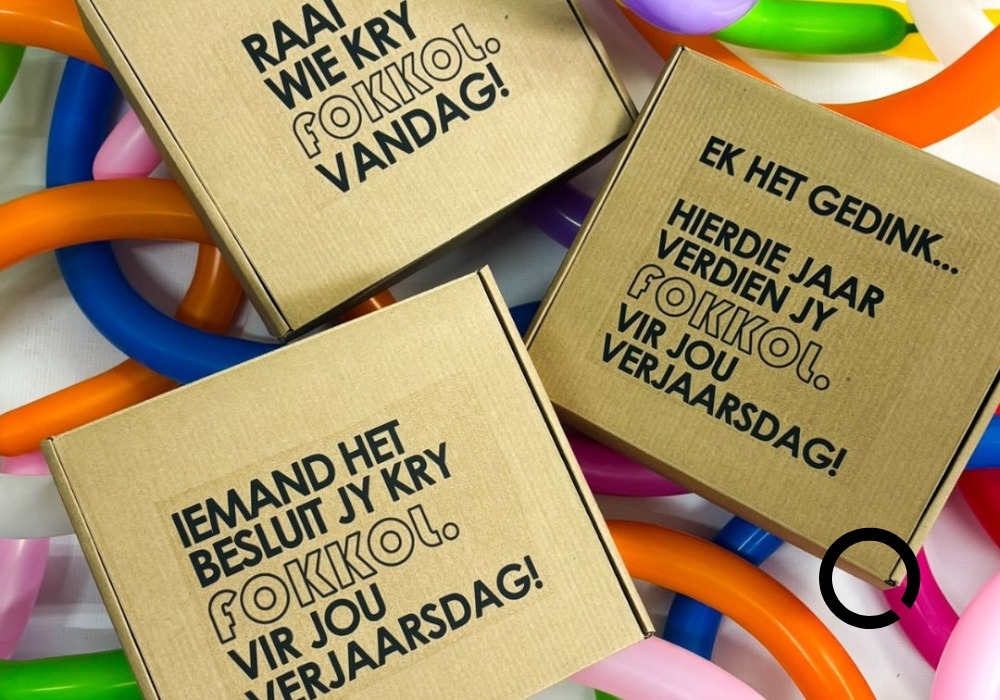
From there, everything the brand touches behaves like media. A tee that reads “FOKKOL Pain FOKKOL Gain” is not only apparel, it is a headline people wear into gyms and weekends. A birthday box that says “Raai wie kry FOKKOL vandag” is not only packaging, it is a gag that shows up in photos and group chats. A bottle of FOKKOL 3-jaar Premium Brandewyn is not only a drink order, it is a punchline you can toast to and tell again.
The voice stays the same wherever you meet it. On the site, in captions, at a stall, or on a bar counter, the mix of Afrikaans and English lands with the same wink. That consistency turns customers into participants. They tag it, gift it, and bring it to events. Each moment adds another proof point that the idea works in the wild.
Because the system is simple, it scales without strain. New drops do not need new rules. Kidswear, headwear, gift boxes, even a cause item can enter the story without breaking the spell. The name remains the anchor, the tone remains the guide, and the community supplies fresh scenes.
In the end, FOKKOL reads like a campaign that never clocks off. One word, held with conviction, meets people in real life, earns a grin, and points them back to where the story continues. Clever brand, light touch, lasting effect.

The why
What type of marketing is this?
Cultural-led brand building. FOKKOL shows how a single, strong idea can operate as a campaign on its own. It relies on cultural truth, language and humour instead of big media budgets. Every product, post and placement is a working touchpoint that reinforces the story.
Why does it work?
Built from a truth. The brand began as a genuine joke about “nothing.” That honesty makes it relatable, not manufactured.
Instant recognition. One word, bold and bilingual, functions as both logo and tagline. No explanation required.
Humour as connector. People share what makes them laugh. Each shirt, bottle or post becomes word-of-mouth media.
Everyday participation. The audience wears, gifts and photographs the brand, extending its reach naturally.
Consistency and tone. The same voice lives in every caption, label and reply, which builds familiarity and trust.
Low friction, high frequency. Because the system is simple, the brand can show up often without wearing out its welcome.

Thy way
Mechanic 1: Treat the brand as media.
Every physical or digital surface should act like an ad. A slogan on a hoodie, a bar mat, a delivery box - each one carries the story without needing campaign artwork.
Mechanic 2: Keep the cue constant.
The word “FOKKOL” is the anchor. Pair it with short, witty lines that change context but not tone. This repetition turns language into a recognisable signature.
Mechanic 3: Meet people in real life.
Show up in the moments where the brand naturally fits - at events, braais, festivals, gyms and markets. When people encounter it mid-routine, the humour lands as lived experience, not advertising.
Mechanic 4: Let the community create.
Encourage customers to share photos, jokes and posts. Repost and celebrate the best of them so fans feel part of the creative team.
Mechanic 5: Expand without overcomplicating.
Add new product lines or collaborations that keep the same energy. New drops should look like new chapters, not new campaigns.
Measurements
Start with attention.
Measure how people actually experience your brand in their everyday context. Track where it naturally shows up and how often people choose to engage. That could be posts shared, mentions, reviews written, QR scans, or web visits from organic sources.
Then look at behaviour.
The key question is what people did next. Did they explore, sign up, add to cart, visit a store, or start a conversation with your brand? Map how quickly and how often these actions happen after the first touchpoint.
Assess commercial impact honestly.
Compare audiences who were exposed to your work with those who weren’t. Look at conversion rates, cost per action, and repeat interactions. Avoid vanity metrics - what matters is sustained behaviour, not bursts of traffic.
Read the brand signals.
Measure what people now think and feel. Are more of them aware of you, understanding you, and choosing you? Do they recognise your tone, trust your message, and talk about you without prompting? Track these consistently over time so your story builds in a straight line, not in spikes.

What to do next
Lead with your clearest cue.
Pick one recognisable signal - a phrase, colour, tone or product feature - and make it consistent across every channel. Repetition builds recall faster than reinvention.
Show up where choices happen.
Every category has its decision points: a shelf, a checkout, a quote request, or a swipe. Treat those moments as media and make your nudge simple and useful.
Shorten the path to value.
From first impression to first action, reduce the number of steps. Keep experiences light, fast, and context-aware. If something adds friction, fix it before scaling.
Build for participation.
Give your audience ways to contribute - through stories, photos, feedback or re-use. The more they co-create, the more your brand earns attention without paying for it.
Maintain the system.
Review assets and links regularly, keep tone consistent, and retire what underperforms. Add new moments gradually so the ecosystem feels alive but coherent.
Measure like a human, optimise like a system.
Use data to inform creative, not to replace it. Balance reach and resonance. Track what works, keep what lasts, and let the brand prove itself through the behaviour it inspires.